Student Connectedness Project
Co-creating welcoming spaces where every student is connected to an adult, peers, and a purpose
About
The Student Connectedness Project invites student teams to become learners, leaders, and designers of school connectedness. Together, students will explore how to ensure that every student is connected to adults, peers, purpose, and a welcoming space.
Through interactive virtual sessions, collaboration, and design challenges, students will create actionable strategies that strengthen connectedness in their schools.
What You’ll Do
- Explore what connectedness looks like
- Learn design thinking tools to co-create and test ideas
- Collaborate with peers and mentors to solve real challenges
- Launch a design sprint for your school/classroom/grade level
Watch this video to learn more about the details of the Student Connectedness Project.
Why it Matters
When students are connected to caring adults, supportive peers, purposeful activities, and welcoming spaces, they thrive. Together, students will co-design schools where connection drives success and every student belongs.
Who Should Join
- Student leadership teams, advisory groups, clubs, etc.
- Adult mentors partnering with students
Sessions & Resources
View videos and download resources shared during the virtual knowledge sessions.
The Four Components of Connectedness

Jeri Crispe of the Everyone Graduates Center discusses the four components of the Student Connectedness Project.
Connected to Adults
The Power of Caring Relationships
Discover how caring adult relationships can change a student’s experience. Design ways your school can ensure every student is “known.”
Connected to Peers
Building Inclusive Communities
Learn strategies to strengthen peer relationships, foster inclusion, and create a sense of belonging across all student groups.
Connected to Purpose
Prosocial Activities That Inspire
Explore how service learning, clubs, and community projects give students purpose and connection. Design opportunities for every student to participate in meaningful, purpose-driven activities.
Connected to a Welcoming Space
Designing Schools Where Everyone Feels Welcome and Supported
Examine what makes a space feel welcoming and inclusive. Design school environments- physical, virtual, and social where everyone feels seen, heard, and valued.
Dream It
Create It
Virtual Events
A series of virtual webinars, planning, and office hours highlight this project. The project will culminate in a Virtual Showcase on April 29, 2026. We offer flexible meeting times for each session at either 11:30am-12:30pm ET and 5:00pm-6:00pm ET.
Connected to Purpose
Prosocial Activities that Inspire
February 25, 2026
-
Explore research on how prosocial engagement builds self-efficacy, empathy, and long-term success
-
Understanding the link between purpose-driven engagement and improved attendance, motivation and graduation outcomes
-
Explore how participation in pro-social activities such as learning, clubs, mentoring, arts, athletics, and community projects help students develop a sense of purpose and belonging
Connected to a Welcoming Space
Co-Designing Schools Where Everyone Feels Welcome and Supported
March 11, 2026
-
Understand how environment, culture, and relationships create safety and belonging
-
Explore how schools can co-design welcoming spaces, both in person and virtually
-
Identify practices that ensure every student feels seen, valued, and respected
Office Hours Sign-up
March 25, 2026
Plan. Design. Create.
Virtual Events
Videos & Resources
These are the videos and resources from our virtual events.
Connected to Peers
Building Inclusive Communitites
February 11, 2026
In this meeting, teams discussed:
- Understanding the role of peer relationships in agency, belonging, and connectedness and the connection to attendance, behavior and course performance
- Explore student-led activities and collaborative learning spaces
- Healthy social media positive peer networks (i.e., the math initiative by the students in DC)
- Shared practices that elevate student voice and shared responsibility
In the second session, a team discussed their findings and the tools they used to collect data on Gaining Multiple Perspectives. The discussion also includes guidance for the Student Connectedness Project’s Virtual Showcase to be held on April 29, 2026.
Download the Session Presentation (PDF)
Session Resources
In this session, we shared resources focusing on social media.
Kelly, Y., Zilanawala, A., Ansari, W., et al. (2023). “Adolescent Social Media Use and Mental Health in the Environmental Influences on Child Health Outcomes Study.” Journal of Adolescent Health
https://www.jahonline.org/article/S1054-139X(24)00825-5/abstract
Valkenburg, P. M., Piotrowski, J., Hermes, J. J., et al. (2024). “The new social landscape: Relationships among social media use, social skills, and offline friendships from age 10-18 years.” Friendship quality in adolescence: the role of social media features, online social support and e‑motions (2022).
https://pubmed.ncbi.nlm.nih.gov/39513051/
Angelini, F., Marino, C., & Gini, G. (2022). Friendship quality in adolescence: the role of social media features, online social support and e-motions. Current Psychology.
Connected to Adults
The Power of Caring Relationships
January 28, 2026
In this meeting, teams discussed:
- Exploring research on how trusting adults can significantly impact student engagement
- Sharing: Practical models, tools for mapping relationships, and other ways students are “known” by adults in the building or at school
- Work together to design opportunities to connect, helping students build trust, support, and lasting relationships with adults and peers
Note: Due to technical difficulties, the final 10 minutes of the session was not recorded. However, no group discussions or additional activities occurred during that time.
Download the Session Presentation (PDF)
Session Resources
Shadowing Resource Links (PDF)
Empathy Interview Resource Links (PDF)
Student Survey Resource Links (PDF)
Community Cafe Resource Links (PDF)
Focus Group Resource Links (PDF)
Kick-Off Meeting
January 14, 2026
The Project Kick-Off Meeting where attendees learned about the Student Connectedness Program and its components.
Communications
Program Description
Download these materials to help promote the Student Connected Program to your peers, students, parents, and community.
Program
Tools
These materials can be used to assist you and your team to engage in design activities.
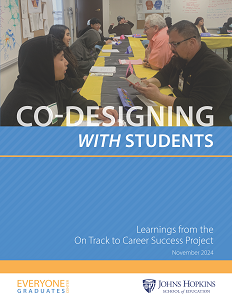 Learnings from the On Track to Career Success Project
This report details the resources that are at the heart of the project’s efforts to co-design with students and the educators, families, and communities who support them.
The On Track to Career Success (OTCS) project is an effort to co-create a framework that seamlessly combines elements of high school redesign, youth development and engagement, workforce development, and career preparation and readiness using evidence-based practices that build skills and open pathways to jobs and careers through educational and workplace experiences.
Resources from Cross State High School Redesign Collaborative
The Cross State High School Redesign Collaborative is a project of the Everyone Graduates Center at Johns Hopkins University built around a hopeful, positive, future-orientated framework to redesign high schools for the 21st Century. They offer a wide variety of evidence-based research, resources, and practices on incporating students and student voice in high school redesign efforts.